Asian Myths and Legends; Realistic Illustrations of Asian Mythology: Chinese Dragons, Japanese gods & monsters, & Asian folklore...
![]() |
||
|
|
Admission Free
Contemporary Mythic Art Gallery
Myths and Legends of Ancient Asia Welcome Friends! If your browser stops loading Art- click refresh Press f11 for full screen mode or - Click control plus the + key to zoom in or Control plus the - key to zoom out! |
|
| NEW REPRINTS LICENSES CUSTOM BOOK COVERS ORIGINAL ART ART INSTRUCTION ART BOOKS and CALENDARS |
| Featuring photo-realistic illustrations of Japanese, Korean, & Chinese folklore & mythology |


|
"The Love Spell of the Tengu"
from Shinto and Buddhist traditional beliefs.
|
|
|
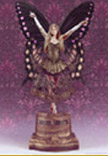
A SHINTO KAMI The term Kami refers to a Shinto or Buddhist revered spirit or god. The Tengu is an example of the Buddhist or Shinto Kami of tradition and is shown here as a very angel-like nature spirit with dark wings. Tengu shape-shifted into many forms over centuries but often appeared as a monstrous anthropomorphized bird ~ usually part woman and cast diverse kinds of spells and performed mischief, not too terribly unlike the Hobgoblin of Irish fairy folklore. Originally seen by Buddhists as disruptive demons or harbringers of war, the tengu's image gradually softened into protective (but still dangerous) spirit guardians of the forests and mountains. Noted for being fond of matchmaking, this Tengu influences a truly charmed romantic encounter in the forest. As a gesture of great respect to a beautiful lady of high social standing, the romantic Samurai bends down in the Sonkyo sitting style still used by Sumo wrestlers today, being careful not to let his knees touch the ground. The Japanese Samurai Warrior shown is in one example of traditional armour ~ this from the Momoyama period wearing a pale blue laced nuinobe fitted with a sode. Although anachronistic, these shoulder pads were still worn by people of rank. |
|
KINTARO - From the folklore of Japan - Legendary symbol of virtue and strength
|
Kintaro is a beloved legendary and symbolic figure from Japan. Like many legendary figures he appears in both history and mythology. According to classic Japanese literature he was fathered by a great Red Dragon ( the thunder god - see below ) who visited his mountain sorceress mother in a dream. She awoke amidst powerful claps of thunder and knew at once she was with child. Kintaro means "Golden Boy" and his jealous uncle sought to kill him. His mother took him and fled into the Hakone mountains to the deepest forests of Mount Kintoki. Growing up deep in the forest his beautiful spirit caused him to become a special friend to all the wild animals, most especially the rabbits and the bears. He loved to play with his animal friends about the rocks of the Yuhi no Taki Falls. So strong was he as a boy and so gifted at Sumo wrestling that he could throw down a bear. He was a very good boy, rosy-cheeked and chubby and always carried a hatchet, the Japanese symbol of the thunder god and is usually depicted riding his beloved bear. One day, when he was nearly grown Yorimitsu Minamoto, the strongest chief of all the Samurai returning from the east (around the 10th century) came upon Kintaro playing with his bear and tossing him about in the mountain forest. |
The great Samurai and his troop of warriors were so delighted to meet such a fine young man with such good manners that they took him immediately to heart! So sure were they that it was God's providence that they enlisted him at once to become one of his retainers. As legend has it, Kintaro then changed his name to Kintoki and served his new master with legendary distinction... To this day, when a Japanese baby boy is born his room is often decorated on Boy's day (May 5th ) with a small Kintaro figurine symbolizing the ideal balance of the masculine virtue of great strength with gentleness. |
|
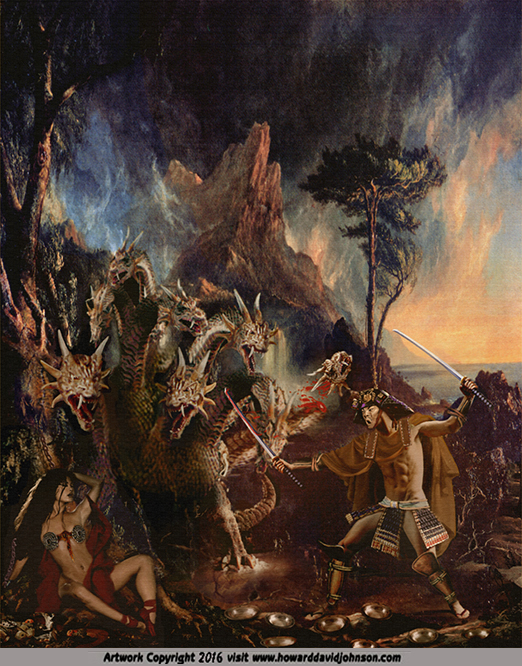
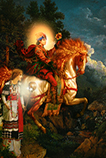
SUSANUO - From Dark Japanese myths and legends of gods and monsters
|
|
Susanuo; a much more ancient variation of the universal thunder god legend from world mythology: One of the greatest characters from Japanese Mythology was Susanuo, the son of Izanagi. He was the god of thunder, fertility and agriculture, very similar to Thor and Zeus from western Mythology. He was cast out of heaven, and his totem was the serpent. He was a dragon slayer of the first rank and killed a great eight headed dragon. He was dressed in a large cloak to disguise his weapons and tricked it by getting it drunk by leaving out eight large bowls of saki.., ( a powerful Japanese liquor made from rice ) Suddenly he threw back his cloak and fell on the monster and cut it to pieces. The poor girl in chains Susanuo rescues in the story was the youngest of eight daughters, and all her sisters were slain as human sacrifices to the great hard drinking eight- headed dragon. Susanuo took her for his wife and she became the legendary princess Kushinada. In the middle of the dragon's tail he found a wonderful magic sword which he pulled out of the bloody carcass and presented to his elder sister Ameraterasu, the goddess of the sun. |
In later stories the sword is given the name Kushinagi and has been transmitted to our own times as one of the three great emblems of Japanese Imperial power. |
|
THE TIGER GIRL - From the folklore of Korea
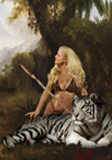
The Tiger Girl from Zong in-Sob's Folk tales from Korea. ( the Brothers Grimm of Korea ).
In old Korea, only the unmarried young people would wear brightly colored clothing. The married people would wear drab tans or grays while the elderly would wear white. In this illustration I have carefully re-created the traditional Korean Hanbok clothing of the era. The worship of nature spirits was common amongst the ancient Asians. In the story, when this boy followed the pretty girl home he got more than he bargained for. I highly recommend these wonderful, innocent and timeless stories for children of all ages...

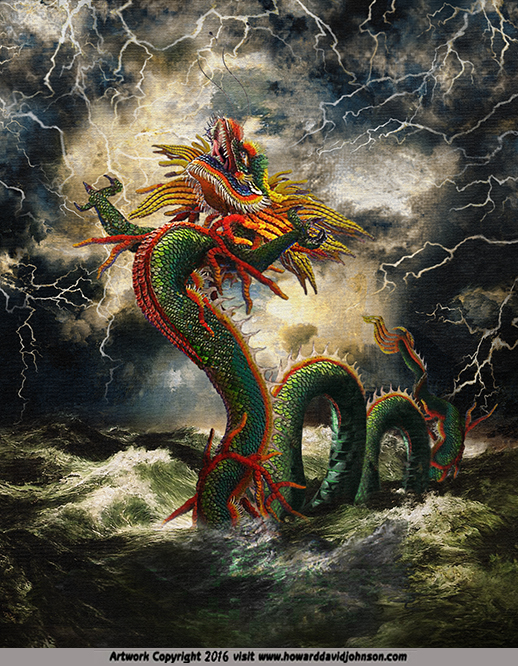
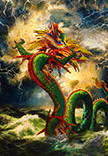
THE CHINESE DRAGON Symbol of the spirit of China
|
|
![]() |
The First dragon
appeared to the mythical emperor Fu-hsi, & filled the hole in the sky made by the
monster Kung Kung. Its waking, sleeping and breathing determined day & night, season
and weather. There are many differences & similarities between the Classical dragon
& the Chinese dragon, these include the ability to fly even without wings,
shape-shifting abilities,& of course the general benevolent behavior to the populace. |
| They rise to the skies in the spring and plunge into the waters in autumn. They could also change color and disappear in a flash. The dragon was also a symbol of the emperor whose wisdom and divine power assured the well-being of his subjects. Many legends draw connections between the dragon and the emperor. Some emperors claimed to have descended from the dragon. According to legend the Dragon had nine sons, and each had a strong personality. There is no general agreement as to what the Dragon's sons are called. However, to most people, they are: 1.Haoxian A reckless and adventurous dragon whose image can be found decorating the eaves of palaces. 2.Yazi Valiant and bellicose; his image is seen on sword-hilts and knife hilts. 3.Chiwen Chiwen likes to gaze into the distance and his appearance is often carved on pinnacles. 4.Baxia Baxia is a good swimmer and his image decorates many bridge piers and archways. 5.Pulao Pulao is fond of roaring and his figure is carved on bells. 6.Bixi Bixi is an excellent pack-animal whose image appears on panniers. 7.Qiuniu Qiuniu loves music and his figure is a common decoration on the bridge of stringed musical instruments. 8.Suanmi Suanmi is fond of smoke and fire; his likeness can be seen on the legs of incense-burners. 9.Jiaotu Jiaotu is as tight-lipped as a mussel or a snail. His image is carved on doors. Nine Dragon Wall A very popular tourist site in Beijing is this Nine-Dragon Wall in BaiHai Park. After hundreds of years, the colours of the ceramic tiles are just as brilliant. The wall was built in 1756. It is 21m long, about 15m high and i.2m thick. It is faced with 424 7-colour ceramic tiles. At the centre of the wall, there is a giant dragon, flanged by four dragons on each side. In addition to these nine large dragons, the wall is covered from edge to edge with many smaller dragons. In all, there are 635 dragons. The Ancient Chinese Dragon occupies a very important position in The mythology of China. It shows up in arts, literature, poetry, architecture, songs, and many aspects of the Chinese conscience. The origin of Chinese dragons is unknown, but certainly pre-dates any written history. | |
|
|
|
|
A DRAGON FROM INDIA
"Krishna and Kaliya the Demon Serpent" MMXI In this story Krishna, the ultimate manifestation of the Hindu God-head is exorcising a ferocious malevolent entity in serpent form who had terrorized the villagers, poisoned the waters, and killed all the nearby wildlife - even birds flying by overhead. Mythology? Of course that depends on your point of view~ more than a billion people do not think this is mythology.
|
|
Thank You For Visiting the Asian Myths & Legends Art page of Howard David Johnson...
All art - paintings, pictures, & text (c) 2012 Howard David Johnson All Rights Reserved
*****
|
ON SALE NOW from BRANDYWINE PRESS! These beautifully printed 11" x 8.5" 64 page hardcover and trade paperback versions feature 48 full page interior plates in full color starting at only $14.99 USD. Less than the price of a single poster! Featuring Realistic Mythological and Fairy Art created in a style inspired by Classic Illustrators by American Artist & Photographer Howard David Johnson. Click on the covers to order from Lulu.com NEW REPRINTS LICENSES CUSTOM BOOK COVERS ORIGINAL ART ART INSTRUCTION ART BOOKS and CALENDARS |
|
|
Enter a world of Beauty and Imagination...
|
![]() |
|||||
| Fairy Paintings | Greek Mythology |
Celtic Mythology | World's Religions | Norse Mythology | Surreal Fantasy Art |
![]() |
![]() |
![]() |
![]() |
||
Asian Mythology |
Symbolist Art |
The Seven Wonders | Res Publica | Legends of History | Spartan Warriors |
|
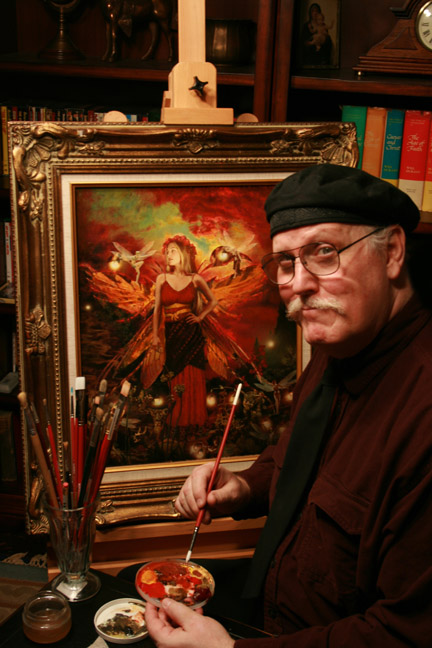
Who is Artist and Photographer Howard David Johnson? In one of David's invitations to the Florence Biennale Contemporary Art Exhibition, (a partner in the United Nations' Dialog among Nations), UN Secretary General Kofi Anon wrote him: "Artists have a special role to play in the global struggle for peace. At their best, artists speak not only to people; they speak for them. Art is a weapon against ignorance and hatred and an agent of public awareness... Art opens new doors for learning, understanding, and peace among nations." Howard David Johnson is a contemporary realistic artist and photographer with a background in the natural sciences and history. David works in a wide variety of mixed media ranging from oil on canvas to digital media. After a lifetime of drawing and painting, David's Traditional Realistic Art was exhibited in the British Museum in London in 1996, ( 3 years before he got his first computer ) as well as numerous American ones since, such as the Metropolitan Museum of Art. David's realistic illustrations have made appearances in every major bookstore and game shop chain in America as well as magazines and educational texts around the world.
Some
of his more prestigious clients have included the National Geographic
Society, the University of Texas, the
University of Cambridge in England, Paramount Studios, Universal Studios, PBS TV, Enslow
Educational Publishers, Adobe Photoshop, Auto FX, Doubleday, the
History Book of the Month Club, & J Walter Thompson Advertising, just to name a
few. Digital illustration projects start at
$500.US. and group rates are available. David delivers custom made copyright free illustrations
& old fashioned
customer service when
he does work-for-hire. To publish
existing pieces of his realistic art,
David sells licenses starting at only $99.USD. Original Oil
Paintings, Colored pencils, Pastels, Mixed media, and Digital art can be commissioned for
select projects - Your business, letters
& links are always welcome. |
This website has been honored by more than 25,000,000 unique visitors from the Four Corners of the Earth: My Friends from around the world thus far : England, Canada, Scotland, Wales, Ireland, Germany, France, Monaco, Andorra, Italy, The Vatican City State, Greece, Macedonia, Cyprus, Turkey, Belgium, Denmark, The Faroe Islands, Greenland, Yugoslavia, Macedonia, Croatia, The Czech Republic, Bosnia, Herzegovina, Slovakia, Slovenia, Luxembourg, Latvia, Estonia, Hungary, Bulgaria, Lithuania, Poland, Austria, Romania, Spain, The Russian Federation, Estonia, Ukraine, Kazakhstan, Moldova, Malta, Iceland, Finland, Norway, Netherlands, Switzerland, Liechtenstein, Sweden, Portugal, Albania, Armenia, Georgia, Slovak Republic, Azerbaijan, Belarus, Kazakhstan, Gibraltar, Israel, Palestinian Territories, Egypt, Libya, Mali, Algeria, Niger, Saudi Arabia, Oman, The United Arab Emirates, Kuwait, Bahrain, Qatar, Yemen, Iraq, Iran, Jordan, Syria, Lebanon, Morocco, Ethiopia, Eritrea, Liberia, The Republic of Congo, Rwanda, Kenya, Angola, Ghana, The Ivory Coast, Zambia, Zimbabwe, Sudan, Nigeria, Namibia, Sudan, Uganda, Kenya, Eritrea, Tanzania, Botswana, Malawi, Senegal, Djibouti, Cameroon, Chad, Gambia, Mozambique, Swaziland, Lesotho, South Africa, Seychelles, Viet Nam, Japan, South Korea, China, Hong Kong, Macau, Mongolia, Mauritius, Singapore, Thailand, Cambodia, Laos, Myanmar, Macau, Malaysia, Taiwan, Nuie, New Zealand, Fiji, Cook Islands, New Caledonia, Vanuatu, American Samoa, Australia, Micronesia, Polynesia, Papua New Guinea, The Heard and McDonald Islands, The Philippines, Guam, Palau, Cocos Island, The Kingdom of Tonga, Malaysia, Brunei Darussalem, India, Pakistan, Afghanistan, Bhutan, Bangladesh, Sri Lanka, Chagos Islands, The Republic of Maldives, Turkmenistan, Kyrgyzstan, Uzbekistan, Tadjikistan, Nepal, Indonesia, Chile, Argentina, Uruguay, Paraguay, Brazil, Peru, Aruba, Venezuela, Bolivia, Suriname, Guyana, Aruba, The Dominican Republic, Guatemala, Costa Rica, Colombia, Trinidad and Tobago, Antigua and Barbuda, Barbados, The Virgin Islands, Saint Lucia, The Netherlands Antilles, Panama, Saint Vincent & Grenadines, Grenada, Ecuador, Belize, Nicaragua, El Salvador, Bermuda, Cuba, Jamaica, Dominica, Haiti, Puerto Rico, Cayman Islands, Anguilla, The Bahamas, Honduras, Mexico, Madagascar, Central African Republic, Ethiopia, Gabon, San Marino, Saint Kitts & Nevis Anguilla, Azerbaidjan, Burkina Faso, Equatorial Guinea, Polynesia, Madagascar, Mauritania, Burundi, and my home, The Great Free State of Texas (USA)... If your home is not listed here please e-mail and tell us where you're from... info@howarddavidjohnson.com We love hearing from you! Your business, letters & links are always welcome. E-mail for courteous service...
"Those who are enamoured of practice without science are like a pilot who goes into a ship without rudder or compass and never has any certainty where he is going. Practice should always be based upon a sound knowledge of theory, of which perspective is the guide and gateway, and without it nothing can be done well in any kind of painting."
Bonus Section: Personal Opinion Essays on Realistic Art yesterday and today by the artist. In addition to his mastery of traditional media, Howard David Johnson now combines drawing, painting, photography, and digital media with more than thirty years of experience in these fields to create his Realistic Art Numérica in 21st century paintings and pictures. Did you know the Greek word "Photography" means "Painting with Light"? Today with the advent of computers it truly lives up to it's name. Due to developments in Art and Technology, a broader definition of painting is needed than that which is found in common usage. Introducing Art Numérica -an exciting merger of traditional visual art and cutting edge technology... a new art form for the twenty- first century... Art Numérica is not limited to realistic art but also offers limitless horizons for everything from cartoons to abstractions. It is the most dramatic development in the visual arts since the Renaissance. In the words of Al Jolson in the movie world's first talking picture" You ain't seen nothin' yet!"
"Painting, in art, the action of laying colour on a surface, or the representation of objects by this means. Considered one of the fine arts" ~Encyclopaedia Britannica. "Painting. noun. 1.) The act or employment of laying on colors or paints. 2.) The art of forming figures or objects in colors on canvas or any other surface, or the art of representing to the eye by means of figures and colors any object; the work of an illustrator or painter. 3.) A picture; a likeness or resemblance in shape or colors. 4.) Colors laid on. 5.) Delineation that raises a vivid image in the mind; as in word painting. ~ Webster's Unabridged Dictionary of the English Language
Essay Two : The Rebirth of Realism More thoughts on realistic art yesterday and today by the artist Art History has entered a new era with the birth of Art Numérica, or digital art media in the 21st century. Artists never stop exploring with mediums. Artists have been developing techniques, experimenting with different tools since at least twenty- five thousand years ago, when the first artist picked up a charred stick and scratched a picture out on the wall of his cave. You'd think everything would have been tried by now, but it hasn't. Exploring new mediums this very day is just as exciting, just as full of freshness and newness as it ever was.
Early abstract art masters proved themselves as realistic artists before delving into realms of the intangible. They had to do this at that time to prove themselves because of the challenges they faced from the establishment for going against the status quo. In the latter part of the 20th century, realistic artists like HDJ were challenged to do abstract art to prove themselves as shown in the example above (Deirdre of the sorrows). Later realistic art training was abandoned in most schools and things like splattering paint in fits of rage were deemed more than enough. By the end of the 20th century something as destructive and ridiculous as nailing a pack of cigarettes to a shoe was considered fine art but not realistic paintings. Fashions in art have often been as silly as fashions in ladies hats. As the century drew to a close, many people had had enough. The realistic revolt was at hand. The rebirth of realism was fueled by the advent of the digital era. Now, for the first time in almost two centuries, an artist or illustrator could earn a decent living again with his realistic art. This is historic. Realistic art is not going to go away, especially now that photography has truly merged with traditional realistic visual art. Photography comes from the Greek words meaning "painting with light". Now with the advent of digital media the capability of realistic art has become almost limitless, truly, "painting with light". The merger of all the world's art forms to realize the potential of motion pictures has come now to still realistic art media. This website for example, on certain pages combines music, prose, poetry, photography and traditional realistic art media to create an experience beyond merely looking at realistic paintings. The twenty- first century is already seeing a new renaissance in the arts because of the world wide web. There has never been anything like it. Abstract art, computer art, photographic art, and realistic art are continuing to be separate schools of art but are also blending to create exciting new horizons. Although Digital art does offer completely new horizons to the artist in the 21st century it does not mean the end of our time honored art traditions. Instead, it offers additional ways to keep these traditions and schools of thought fresh and alive. ~ HDJ *****
NEW REPRINTS LICENSES CUSTOM BOOK COVERS ORIGINAL ART ART INSTRUCTION ART BOOKS and CALENDARS All art - paintings, pictures, & text (c) 1993- 2012 Howard David Johnson All Rights Reserved Thank You For Visiting the Asian Myths & Legends Art page of Howard David Johnson... Your business, letters & links are always welcome. ***** Look for more Asian myths and legends art - More Japanese Mythology - Korean Mythology - & Chinese Mythology - Coming soon... |

|||||||||||||||||||||||